

One of the biggest advantages of the E-2 treaty investor visa is that as long as your business keeps qualifying, you can keep renewing it. But “renewal” means two different things in E-2 practice, and mixing them up is one of the most common mistakes we see investors make.
United States Citizenship & Immigration Services (USCIS) Renewal vs. Visa Renewal at a U.S. Embassy or Consulate
You can extend your E-2 status with USCIS while you stay in the United States, or you can apply for a new E-2 visa at a U.S. embassy or consulate abroad. Each route has its own forms, timing and travel rules. This guide explains how long an E-2 lasts, how many times you can renew, how each route works, what documents officers expect, and how your spouse and children fit in.
Quick Answer: How Does E-2 Visa Renewal Work?
| Question | Short answer |
|---|---|
| How long can I stay on each entry? | Generally up to 2 years per admission, shown on your Form I-94 |
| How long is the visa in my passport valid? | It depends on your nationality’s reciprocity schedule, up to 5 years for some countries and much shorter for others. See U.S. Visa: Reciprocity and Civil Documents by Country |
| How many times can I renew? | There is no limit, as long as you still qualify and intend to depart when your status ends. (Applicants filing for permanent resident status should consult counsel before filing any immigrant petition or traveling while one is pending.) |
| Can I renew without leaving the U.S.? | You can extend your status with USCIS, but that does not give you a new visa for travel |
| Where do I get a new E-2 visa? | At a U.S. embassy or consulate, generally in your country of nationality or residence. See Adjudicating Nonimmigrant Visa (NIV) Applicants in Their Country of Residence |
| Will I need an interview? | Plan for one; E-2 renewals are not on the State Department’s interview waiver list |
| What does it cost? | Government fees change often, so check the official fee pages or email us for a current quote |
What Is the Difference Between Your E-2 Visa and Your E-2 Status?
This distinction drives almost every renewal decision.
- Your visa is the foil in your passport. It is a travel document that lets you ask to be admitted at a U.S. port of entry. The State Department issues it, and its validity is set by the reciprocity schedule for your nationality.
- Your status is your permission to be in the United States. U.S. Customs and Border Protection (CBP) sets it each time you are admitted and records an “admit until” date on your Form I-94.
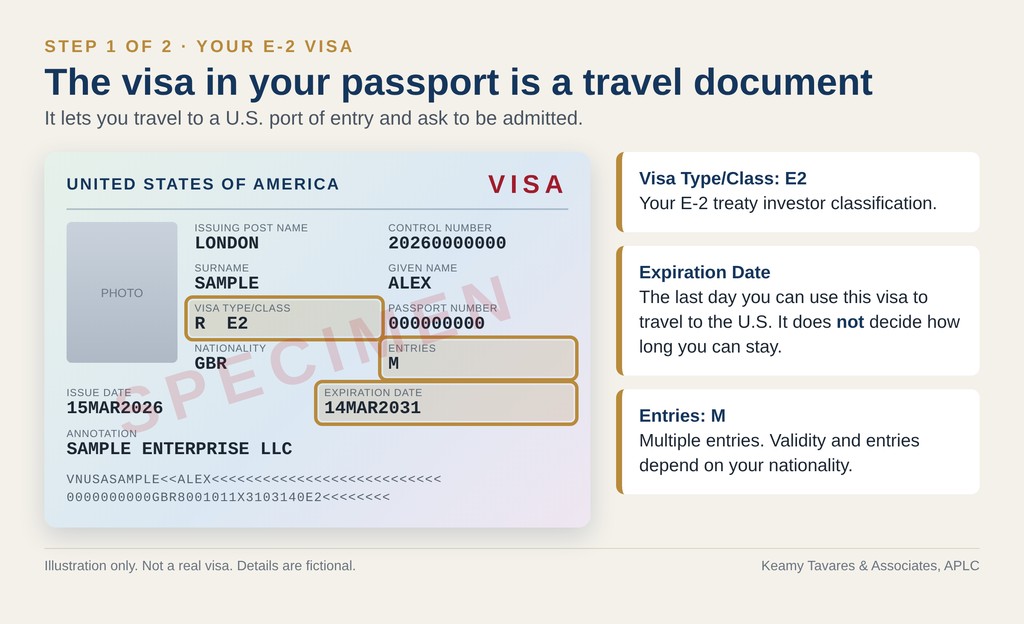
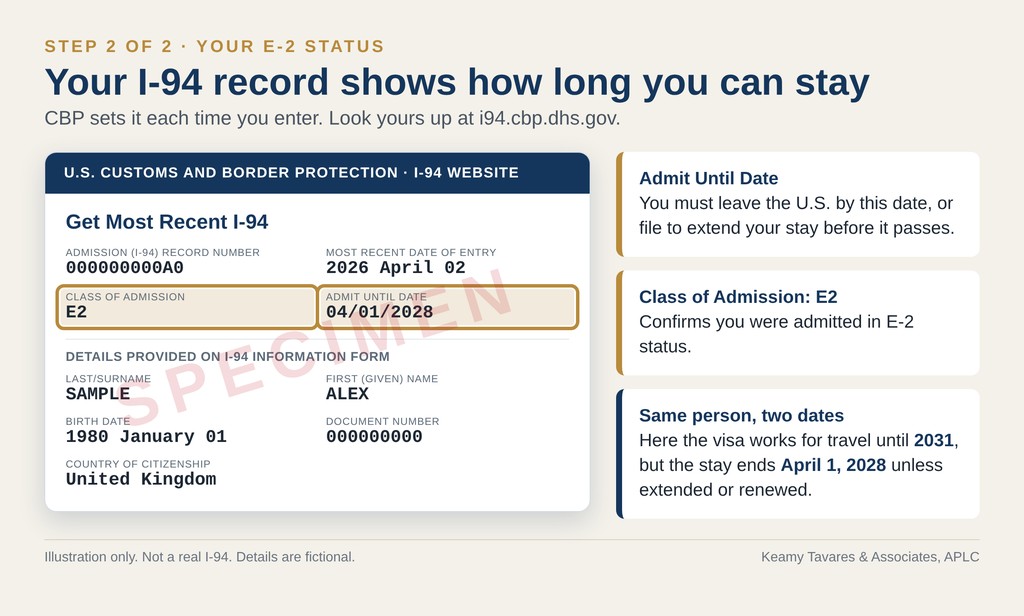
The two dates are independent. The State Department explains on its visa expiration date page that the date on your I-94 is the date by which you must leave. So your visa can expire while you are lawfully in the U.S., and you can hold a valid visa while your I-94 date is about to pass. You can check your most recent I-94 on the CBP I-94 website.
How Long Is an E-2 Visa Valid?
There are three dates to track, and they rarely line up:
- Your visa’s expiration date. The State Department sets visa validity by nationality in its reciprocity schedules. Some treaty nationals receive E-2 visas valid for up to five years. Others receive much shorter visas.
- Your I-94 “admit until” date. Under 8 CFR 214.2(e)(19), an E-2 investor may be admitted for an initial period of up to two years. USCIS notes that an E-2 nonimmigrant who travels abroad may generally be granted a new two-year period of readmission on returning, if CBP finds them admissible.
- Your passport’s expiration date. The same regulation says you generally cannot be admitted in E status for more than six months beyond your passport’s expiration.
An expiring passport can shorten your stay, so renew it early.
How Many Times Can an E-2 Visa Be Renewed?
There is no set limit. USCIS states on its E-2 Treaty Investors page that extensions may be granted in increments of up to two years each, and there is no limit to the number of extensions an E-2 nonimmigrant may be granted. Federal regulations say the same: there is “no specified number of extensions of stay” for a treaty investor.
The catch is that every renewal is a fresh look at your eligibility. To keep renewing, you need to show that:
- The business is still real and operating. It is actively doing business, not just holding funds or existing on paper.
- The business is more than marginal. Under the State Department’s rules in 9 FAM 402.9, it must have the present or future capacity to do more than provide a minimal living for you and your family.
- You still develop and direct the business. You remain in control of the enterprise.
- You intend to depart when your E-2 status ends. The E-2 is a nonimmigrant classification, so this intent is still required.
Renewing Inside the U.S. vs. at a Consulate Abroad
Most investors use one route or a combination of both over the years. Here is how they compare:
| Extension of status with USCIS | New visa at a U.S. embassy or consulate | |
|---|---|---|
| Where you are | Physically in the United States | Abroad, generally in your country of nationality or residence |
| Main form | Form I-129 with the E supplement; Form I-539 for family members | DS-160 online application, plus the post’s own E-2 document checklist |
| What you get | A new authorized stay of up to 2 years | A new visa in your passport, then a new admission of up to 2 years when you enter |
| Can you travel on it? | No. An approval notice is not a visa | Yes, for the life of the visa |
| Best for | Investors who do not need to travel soon | Investors who travel or whose visa has expired |
Extending your E-2 status with USCIS
If you are in the U.S. and your I-94 date is approaching, you can request an extension of stay. Under 8 CFR 214.2(e)(20), you must show that you have maintained your E-2 status at all times, that you were physically present in the U.S. when you filed, and that you have not abandoned the request.
A few practical points matter here:
- It is critical that you file before your I-94 date passes. A late filing can leave you out of status.
- Work can continue while the case is pending. Under 8 CFR 274a.12(b)(20), a treaty investor whose extension was filed on time may keep working for the same enterprise for up to 240 days after the I-94 date, unless USCIS denies the case first.
- Talk to us before you travel. Leaving the U.S. while an extension is pending can affect the request.
- An approval does not put a visa in your passport. If your visa has expired and you travel, you will need a new visa from a consulate before returning.
Renewing your E-2 visa at a U.S. embassy or consulate
To get a new visa, you apply at a U.S. embassy or consulate abroad. Keep these points in mind:
- Where to apply. The State Department directs nonimmigrant visa applicants to schedule interviews at the embassy or consulate in their country of nationality or residence.
- Interview. The State Department’s interview waiver guidance, effective October 1, 2025, does not include E-2 renewals in its waiver categories, so plan for an in-person interview.
- Each post has its own checklist. Embassies publish their own E-2 renewal instructions, document order and page limits. Always follow the post you are applying to.
- Wait times vary. Check the State Department’s Global Visa Wait Times tool before you book travel, and do not make firm plans until the visa is in your passport. Any previous visa violations, prior Immigrant Visa Applications or criminal matters will impact visa processing.
When Should You Start Your E-2 Renewal?
Earlier than most people think. Gathering tax returns, financial statements and payroll records takes time, and appointment availability changes from month to month. Use this checklist:
- Note your visa, I-94 and passport expiration dates in one place.
- Renew your passport first if it is close to expiring.
- Decide whether you need to travel. If you do, a consular renewal is usually the route.
- Start collecting business records several months before your earliest deadline.
- Book a consulate appointment early, or file your USCIS extension well before your I-94 date.
- Confirm the current government fees on the official pages the week you file.
What Documents Do You Need for an E-2 Renewal?
Requirements vary by post, but the U.S. Embassy in London’s E-2 renewal checklist is a good example of what officers look for:
- Cover letter explaining the enterprise and how it still meets each E-2 requirement
- Forms: DS-160 confirmation and proof that the visa application fee was paid
- Applicant documents: passport, prior U.S. visas, I-94 records and any USCIS approval notices (Form I-797)
- Ownership: company formation documents and records confirming who owns the business
- Investment: evidence of any major new investments since your last approval
- Real and operating: invoices, client agreements, marketing materials and bank records
- More than marginal: U.S. federal tax returns for the business, profit and loss statements, and payroll records such as Form 941 quarterly returns and W-3s
If your business has changed
London’s checklist notes that if you no longer operate the business you were approved for, you must submit the full set of documents required of first-time investors. Selling the company, buying a new one or making major ownership changes can turn a renewal into a new application. Call us before you make the change, not after.
What Happens to Your Spouse and Children When You Renew?
Your family’s status follows yours. Under 8 CFR 214.2(e)(19), your spouse and minor children are admitted for the period you are in valid E-2 status. When you renew, they renew too.
- Inside the U.S.: USCIS says family members can apply for their extension together on a single Form I-539.
- Abroad: each family member applies for their own E-2 visa at the consulate.
- Spouse work rights: USCIS treats spouses in valid E-2 status as employment authorized incident to status. Since January 30, 2022, USCIS and CBP have issued I-94s marked “E-2S” for spouses, which can be used as proof of work authorization.
- Children: unmarried children under 21 qualify as dependents but are not authorized to work. A child who turns 21 no longer qualifies as an E-2 dependent and will need another status, so plan ahead for older teens.
What Does an E-2 Visa Renewal Cost?
The cost of an E-2 renewal depends on which route you take, how many family members are renewing and your nationality. Government fees change often, sometimes more than once a year, so we do not publish fee amounts here. Instead, here is what to expect and where to find the current numbers:
- Consular renewal: a nonrefundable visa application fee for each applicant, including your spouse and each child. See the State Department’s Fees for Visa Services.
- Visa issuance (reciprocity) fee: charged by some countries’ schedules after the visa is approved, based on each applicant’s nationality. See your country’s reciprocity schedule.
- USCIS extension: a filing fee for Form I-129 and any related program fees, plus a separate fee for your family’s Form I-539. See the USCIS Fee Schedule (Form G-1055).
- Optional premium processing: available for USCIS extension filings for an added fee. See USCIS premium processing.
- Other costs: legal fees, accounting help with financial statements, document translations and travel to the consulate.
Because fees change so often, we confirm the current costs for your situation by email before you file. Contact our office and we will send you an up-to-date estimate.
Frequently Asked Questions
Is an E-2 visa renewable indefinitely?
Yes, in the sense that there is no cap on the number of renewals or extensions. Each renewal is a new review, though, so your business must still be real, operating and more than marginal, and you must still intend to depart when your status ends.
Can I renew my E-2 visa in the United States?
You can extend your E-2 status with USCIS without leaving the country. A new E-2 visa in your passport, which you need for travel once your current visa expires, comes from a U.S. embassy or consulate abroad.
Do I have to leave the U.S. when my E-2 visa expires?
Not necessarily. What controls your stay is the “admit until” date on your Form I-94, not the visa’s expiration date. If your I-94 is still valid, you can generally remain in the U.S. in E-2 status even after the visa expires.
What if my business is not profitable yet?
Profit is not the only test, but officers will look at whether the business is more than marginal and growing as planned. Tax returns, payroll records and financial statements carry a lot of weight at renewal, so keep them organized from the start.
Does my spouse need a work permit after we renew?
Generally not. USCIS treats E-2 spouses in valid status as employment authorized incident to status, and an unexpired I-94 marked “E-2S” can serve as proof. Check the current USCIS guidance on acceptable documents before your spouse starts a new job.
Can I sell my business and still renew my E-2?
A sale or major change usually means a new application rather than a simple renewal, because the new business has to qualify on its own. Speak with an attorney before you sign anything.
Does an E-2 investment lead to a Green Card?
The regulations do not allow for the E-2 visa to convert directly into permanent residence. The E-2 is a nonimmigrant classification, and holders must intend to depart the United States when their status ends. There is no “E-2 to green card” category. However, an E-2 investor may pursue permanent residence through a separate immigrant category if they qualify. Common options include:
- EB-5 Immigrant Investor, if the investment meets the higher EB-5 minimum and creates 10 full-time U.S. jobs. The minimum is currently $1,050,000, or $800,000 in a Targeted Employment Area. These amounts go up automatically on January 1, 2027, so check the USCIS page for the current figures
- EB-1C Multinational Manager or Executive, if the U.S. business has a qualifying relationship with a foreign company that employed the investor abroad for at least one year
- EB-2 National Interest Waiver, if the investor’s work is of substantial merit and national importance
- Employer sponsorship (PERM) or family-based petitions, where available
Filing for permanent residence can affect future E-2 renewals, because the E-2 is not a “dual intent” visa. Speak with an attorney before you begin any green card process.
How do mergers affect my E-2 treaty investment?
A merger or acquisition can affect both your E-2 status in the U.S. and your E-2 visa abroad.
In the U.S. (USCIS, 8 C.F.R. § 214.2(e)(8)): A merger is a “substantive change.” USCIS must approve it on a new Form I-129 before it takes effect. Making the change without approval may end your E-2 status.
At the consulate (9 FAM 402.9): After a change in ownership, the officer will not rely on earlier findings and will review your case again (9 FAM 402.9-6(D)). Treaty nationals must still own at least 50% of the business (9 FAM 402.9-4(B)), and you must still develop and direct it (9 FAM 402.9-6(F)).
Approval from one agency does not bind the other. Consult counsel before signing any merger agreement.
Plan Your E-2 Renewal With a San Diego Immigration Attorney
A smooth E-2 renewal comes down to knowing your dates, choosing the right route and showing that your business has done what you said it would do. Investors who keep good records from day one usually find renewals far less stressful.
Keamy Tavares & Associates, APLC has helped entrepreneurs and investors with U.S. immigration for more than 20 years from our office at 12636 High Bluff Drive, Suite 400, San Diego. Whether you are renewing for the first time or the fifth, talk to us about your E-2 renewal or call +1 619-789-6628. For the basics of qualifying, see our guide on how to get your E-2 treaty investor visa and our E-2 and L-1A visa FAQs.
Sources
- USCIS, E-2 Treaty Investors
- USCIS, Form I-129, Petition for a Nonimmigrant Worker and Form I-539
- Electronic Code of Federal Regulations, 8 CFR 214.2(e) and 8 CFR 274a.12
- U.S. Department of State, 9 FAM 402.9, Treaty Traders and Investors
- U.S. Department of State, What the Visa Expiration Date Means
- U.S. Department of State, Adjudicating Nonimmigrant Visa Applicants in Their Country of Residence and Interview Waiver Update
- U.S. Embassy London, Renewal of Treaty Investor Visa (E-2)
- U.S. Department of State, Fees for Visa Services and Reciprocity Schedules
- USCIS, Fee Schedule (Form G-1055)
- USCIS Policy Manual, Volume 6, Part G, Chapter 2: Investment Requirements
Disclaimer: This article is for general information only and is not legal advice. Immigration rules, fees and procedures change often, and every case depends on its own facts. Please consult a licensed immigration attorney about your situation before making filing or travel decisions.